Unhinged and Anonymous: Tracking Down the Rogue Customer Who Is Defaming Your Business Online
Every business will eventually encounter one. The customer who posts fabricated or wildly exaggerated reviews across Google, Facebook, Trustpilot and every other platform they can find. They operate under fake names. They escalate relentlessly. Their objective is simple: extract a financial advantage by holding your reputation to ransom.
If this is happening to your business, you are not powerless. Australian law provides a range of remedies. But the right approach depends on your specific circumstances, the nature of the publications, the structure of your business and the commercial realities of your situation. This article explains the tools available and how we might deploy them on your behalf.
Recognising the Pattern
The rogue customer typically exhibits a distinct behavioural pattern. A complaint is raised, often contrived or based on a genuine but minor grievance inflated beyond all proportion. When the business does not capitulate to an unreasonable demand, the customer begins posting negative reviews under pseudonyms across multiple platforms. The volume and severity of posts escalate over time. The customer may contact the business directly, linking the cessation of reviews to payment or other concessions. This conduct can itself amount to extortion under the Crimes Act 1958 (Vic) or equivalent Commonwealth legislation.
The commercial harm is real. Studies consistently show that a single one-star review can reduce revenue by five to nine per cent. A sustained campaign by a motivated individual can be devastating. If you are experiencing this pattern, contact us early. The sooner we are engaged, the more options are available.
Preserving the Evidence
One of the first things we would advise is comprehensive evidence preservation. Screenshots are a starting point but are not sufficient on their own. Best practice includes certified web captures using tools such as Archive.org's Wayback Machine or Conifer, preservation of metadata including timestamps, URLs, platform identifiers and user profile data, and a chronological log of all communications with the individual across all channels.
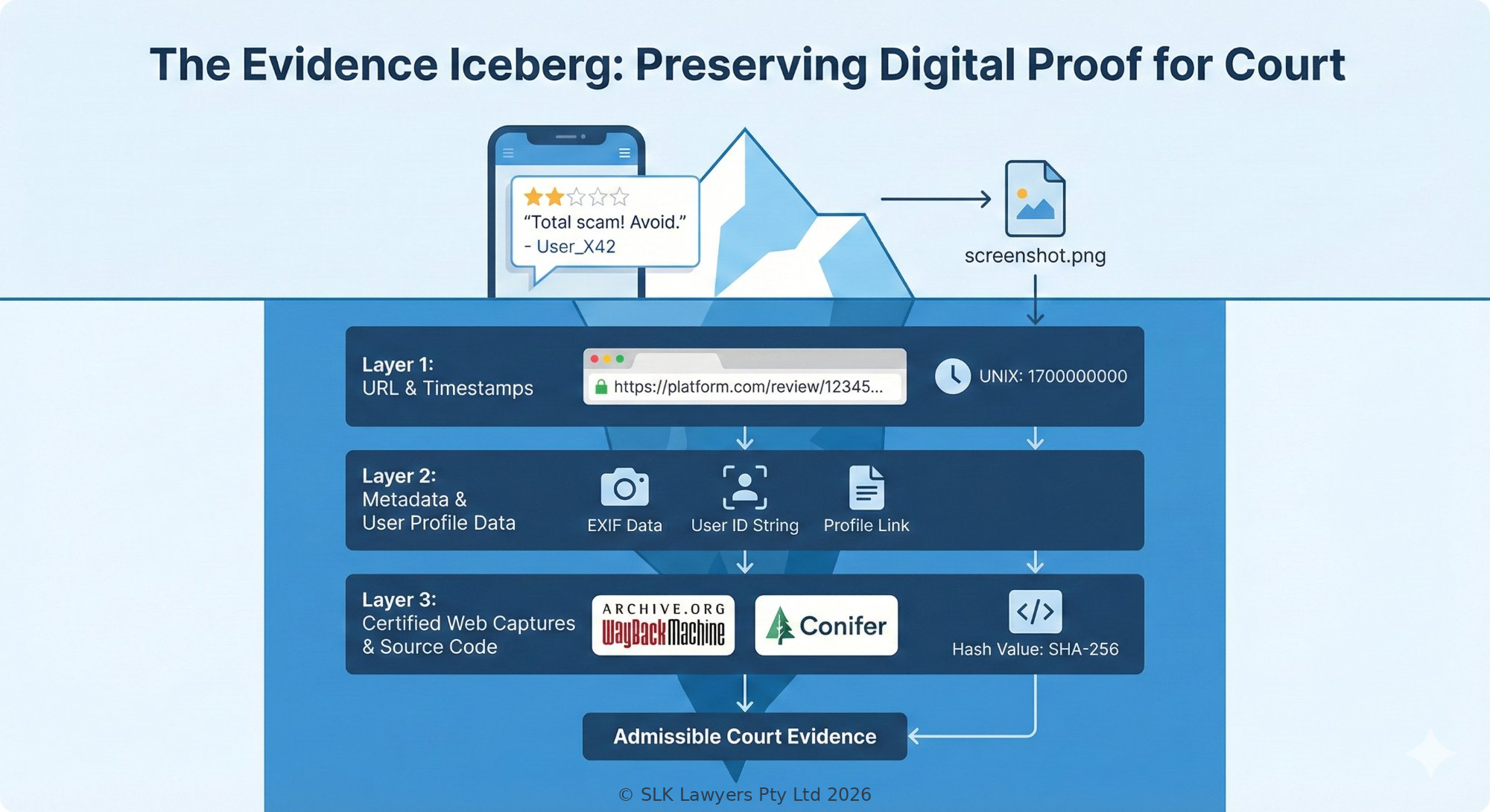
We would also advise your staff not to engage with the individual online. Anything said may complicate later proceedings. Evidence needs to be stored in a manner that maintains its integrity for use in court. We can guide you through this process.
Assessing the Available Causes of Action
The legal framework available to your business depends critically on whether the plaintiff is a natural person (sole trader or partner) or a corporation, and if a corporation, its size and corporate structure. This distinction shapes the entire litigation strategy. It is one of the first things we would assess in a consultation.
Defamation
Under the Defamation Act 2005 (Vic), a plaintiff must establish that the defendant published defamatory matter to a third party and that the matter identified the plaintiff. The publication must convey one or more defamatory imputations, meaning it lowers the plaintiff in the estimation of ordinary, reasonable members of the community.
The serious harm threshold. Since the Stage 1 reforms (commenced 1 July 2021 in Victoria), section 10A of the Defamation Act 2005 (Vic) requires the plaintiff to prove that the publication has caused, or is likely to cause, serious harm to their reputation. This is a mandatory element of the cause of action. It displaces the former common law presumption that harm flows naturally from defamatory publication. For corporations, section 10A(2) imposes an additional requirement: harm to a corporation's reputation is not serious harm unless it has caused, or is likely to cause, the corporation serious financial loss.
In practice, this means we would need to help you gather evidence of actual reputational damage and, for corporate plaintiffs, financial impact. Evidence may include loss of customers, reduced revenue, cancelled contracts or a measurable decline in enquiries traceable to the offending publications. A delay in bringing proceedings can itself undermine a serious harm argument, as courts have observed that delay may suggest the plaintiff was not particularly troubled by the publication. This is another reason to engage us early.
Can your corporation sue in defamation? Under section 9 of the Defamation Act 2005 (Vic), a corporation has no cause of action for defamation unless it is an "excluded corporation" at the time of publication. A corporation qualifies as an excluded corporation if its objects do not include obtaining financial gain for its members (that is, it is a not-for-profit), or it has fewer than 10 employees and is not an associated entity of another corporation (within the meaning of section 50AAA of the Corporations Act 2001 (Cth)). The corporation must also not be a public body.
Critically, the definition of "employee" under section 9 is broad. It includes any individual, including an independent contractor, who is engaged in the day-to-day operations of the corporation and is subject to its control and direction. Part-time workers count as a fraction of a full-time equivalent. The recent Queensland District Court decision in Deep Cycle Systems Pty Ltd v Fischer [2025] QDC 25 confirms that courts scrutinise the excluded corporation threshold strictly. In that case, the plaintiff failed to establish excluded corporation status and its defamation action was dismissed.
We would carefully assess your corporate structure and workforce composition before advising on whether a defamation claim is viable. If your business cannot satisfy the excluded corporation test, defamation is not available. Other causes of action may be more appropriate.
Individual claims alongside corporate claims. Section 9(5) of the Defamation Act 2005 (Vic) preserves the right of an individual associated with a corporation to sue in defamation for publications that defame them personally, even if the same publication also defames the corporation. Where the rogue customer's reviews attack the business owner by name or in terms that identify them personally, a personal defamation claim may run alongside (or instead of) a corporate claim. This is a strategy we regularly consider.
When the business is the owner. Even where the reviews name only the business and do not refer to the owner by name, the owner may still be personally identified by the publication. In Bargold Pty Ltd v Mirror Newspapers Ltd [1981] 1 NSWLR 9, the Court recognised that an imputation concerning a corporation may also reflect on a corporate officer, particularly where that person is the "alter ego" of the business. The question is whether the ordinary reasonable reader, aware of the circumstances, would understand the publication to convey a defamatory imputation about the individual. Factors relevant to this assessment include whether the individual is the sole director and shareholder, the size of the business (the smaller the business, the stronger the identification), whether the individual is the public face of the operation (for example, the person who personally delivers the services being criticised), whether the business trades under or is publicly associated with the individual's name, and whether the imputations necessarily reflect on the individual's personal competence, honesty or character rather than on the business as a separate entity. In the rogue customer context, this arises frequently. A one-person consulting firm, a sole practitioner, or a trades business operated by its owner-director will often be so closely identified with that individual that a review attacking the business is, in substance, an attack on the person. We would assess this question carefully, because if identification can be established, the individual may have a personal defamation claim regardless of whether the corporation satisfies the excluded corporation test.
Injurious Falsehood
Injurious falsehood (also called malicious falsehood) is available to all plaintiffs, including corporations of any size. It is often the primary cause of action for larger businesses that cannot access defamation. The elements, as stated by the High Court in Palmer Bruyn & Parker Pty Ltd v Parsons [2001] HCA 69, are:
- The defendant published a false statement of or concerning the plaintiff's goods, services or business.
- The statement was published to a third party.
- The statement was published maliciously.
- The plaintiff suffered actual damage as a direct result.
Several features of injurious falsehood are important in the rogue customer context.
Falsity. Unlike defamation, where the statement is presumed false unless the defendant proves truth, in injurious falsehood the plaintiff bears the onus of proving falsity. The statement must relate to the plaintiff's goods, services or business (not merely to the character of a person).
Malice. The plaintiff must prove malice, meaning the defendant published the statement with knowledge of its falsity, reckless indifference to its truth, or with the dominant purpose of injuring the plaintiff. This is a higher bar than defamation requires. However, in the rogue customer scenario, malice is often readily inferred from the pattern of conduct: the use of pseudonyms, the escalation following a demand for payment, and the disproportionate nature of the complaints.
Actual damage. The plaintiff must prove actual, quantifiable damage. A mere likelihood of harm is insufficient. This typically requires evidence of lost revenue, lost customers or other measurable financial loss directly attributable to the false publications. Expert evidence (forensic accounting, marketing analysis) may be necessary to establish the quantum. We would work with you to identify and quantify the loss.
Practical advantages. Injurious falsehood has a six-year limitation period, compared to the one-year period in defamation (with a possible extension to three years in limited circumstances). Importantly, the Bonnard v Perryman principle restricting interlocutory injunctions does not apply to injurious falsehood with the same force as it does in defamation. Courts accept that injunctions are more readily available for injurious falsehood because the tort protects economic rather than personal interests, and free speech concerns carry less weight. Exemplary damages may also be awarded.
Misleading or Deceptive Conduct
Section 18 of the Australian Consumer Law (Schedule 2 to the Competition and Consumer Act 2010 (Cth)) prohibits conduct in trade or commerce that is misleading or deceptive or likely to mislead or deceive. Posting fabricated reviews, or reviews under a false identity that misrepresent the reviewer's experience, can constitute a contravention.
This cause of action has practical advantages. There is no requirement to prove malice. The court can grant injunctive relief under section 232 of the ACL. Damages for economic loss are recoverable under section 236, though the plaintiff must prove loss flowing from the contravening conduct. The limitation period is six years.
One important qualification: section 18 applies to conduct "in trade or commerce." A disgruntled consumer posting reviews in a purely private capacity may fall outside this requirement. However, where the conduct is calculated to interfere with the plaintiff's commercial operations, or where the reviewer's conduct itself has a commercial character (such as seeking to extract a financial concession), the trade or commerce element may be satisfied. This is a factual question we would assess based on the specific circumstances of your case.
Other Potential Claims
Depending on the facts, we may also consider tortious interference with contractual or business relations (where the conduct is directed at deterring your customers or suppliers), stalking and harassment under the Personal Safety Intervention Orders Act 2010 (Vic) or the criminal stalking provisions in section 21A of the Crimes Act 1958 (Vic), and extortion where the individual links cessation of the campaign to a payment demand.
The right cause of action (or combination of causes of action) depends on your circumstances. We would assess the full picture before recommending a strategy. Get in touch to discuss your options.
Unmasking the Anonymous Poster
This is often the central challenge. The rogue customer hides behind pseudonyms. Identifying them requires a combination of technical investigation and legal process. We have experience coordinating both.
Deploying Cyber Investigators
We work with specialist cyber investigators who employ a range of tools and techniques to identify anonymous posters.
Open source intelligence (OSINT). Investigators scrape publicly available data across platforms. A pseudonymous account on Google Reviews may share a username, profile image, writing style or other identifiers with accounts on other platforms where the individual has been less careful about concealing their identity.
Linguistic analysis. Forensic linguists can analyse writing patterns, vocabulary, syntax and common errors to establish authorship attribution, linking anonymous posts to known communications from the suspect.
Data matching across databases. Investigators cross-reference email addresses, phone numbers, IP addresses and other identifiers harvested from public and commercial databases. A single data point, such as a phone number used to verify a fake Google account, can unravel an entire network of pseudonyms.
Reverse image searches and metadata analysis. Profile images used on fake accounts may appear elsewhere online linked to a real identity. Image metadata (EXIF data) can reveal device information and geolocation.
Technical tracking. Where the suspect interacts with the business's own digital assets (website, emails), server logs, analytics data and email header analysis can yield IP addresses and device fingerprints.
The output of a cyber investigation provides two things: a reasonable basis for identifying the suspect, and intelligence to support the legal processes that follow. In many cases, a well-targeted investigation can resolve the identification question without the need for court proceedings, saving significant cost.
Preliminary Discovery
Where investigation alone does not conclusively identify the poster, or where admissible evidence of identity is required, we may apply for preliminary discovery.
In Victoria, Regulation 32.05 of the Supreme Court (General Civil Procedure) Rules 2015 (Vic) allows a prospective plaintiff to apply for an order compelling a person to give discovery of documents to assist in identifying a prospective defendant. In the Federal Court, rule 7.22 of the Federal Court Rules 2011 (Cth) serves the same purpose. Equivalent provisions exist in each state jurisdiction.
The court must be satisfied that there may be a right for the prospective applicant to obtain relief against the prospective respondent, the applicant is unable to ascertain the identity of the respondent, and the person against whom the order is sought is likely to have documents that would assist in identification.
Section 23A of the Defamation Act 2005 (Vic), introduced as part of the Stage 2 reforms (commenced 11 September 2024 in Victoria), provides an additional framework for preliminary discovery directed specifically at identifying anonymous publishers of defamatory matter. This section requires courts to consider privacy and safety issues before making orders, but is unlikely to impede applications in the commercial rogue customer context.
In practice, we would direct these applications at platform operators (Google, Meta, Trustpilot), internet service providers to disclose subscriber information associated with an IP address, and telecommunications providers to match phone numbers used for account verification.
The cases of Kabbabe v Google LLC [2020] FCA 126 and Musicki v de Tonnerre [2023] FCA 222 illustrate the process. In Musicki, a vascular surgeon obtained preliminary discovery against Google to identify the author of a pseudonymous negative review. Google was compelled to disclose account registration information, revealing that the reviewer was a disgruntled former student operating under a false name. Dr Musicki ultimately obtained judgment in her favour, with the respondent ordered to pay over $450,000 in damages, plus costs and interest.
Platforms headquartered overseas may resist compliance. However, Google and Meta both maintain Australian legal process teams and regularly comply with properly served orders. The court may also grant leave for service out of the jurisdiction or extrajudicial service where necessary.
Subpoenas
Subpoenas are a distinct and complementary tool to preliminary discovery. A subpoena can only be issued once proceedings are on foot. In a preliminary discovery application, the application itself constitutes the proceeding, so subpoenas may be issued in support of (or as an alternative to) preliminary discovery orders once that application is filed.
What a subpoena is. A subpoena is a written order issued by the court, at the request of a party, directed to a third party who is not involved in the proceedings. It compels the recipient to produce documents, attend to give oral evidence, or both. In Victoria, subpoenas are governed by Order 42 of the Supreme Court (General Civil Procedure) Rules 2015 (Vic). In the Federal Court, the relevant provisions are Part 24 of the Federal Court Rules 2011 (Cth).
Why subpoenas matter here. While preliminary discovery orders direct a respondent to give discovery of documents relating to a prospective defendant's identity, a subpoena for production is a broader and more coercive instrument. Non-compliance without lawful excuse is a contempt of court, which may result in arrest and punishment. This coercive force makes subpoenas particularly effective against third-party entities that might otherwise be slow or uncooperative.
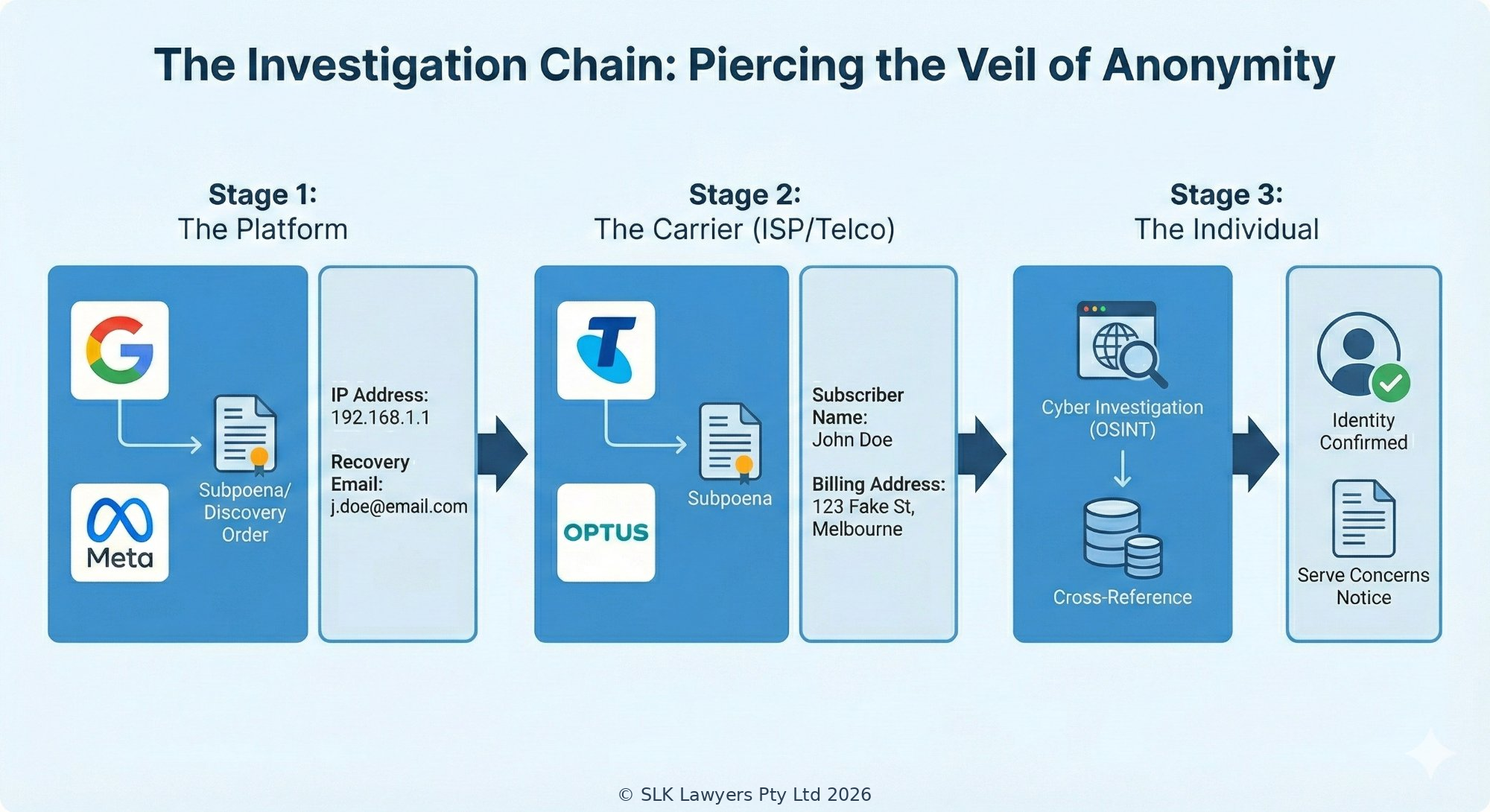
The two-step identification process. In practice, unmasking an anonymous online poster through subpoenas typically follows a two-step sequence that we would manage on your behalf.
Step one: Subpoena the platform. We issue a subpoena for production to the platform operator (Google, Meta, Trustpilot or other review site) requiring production of account registration information associated with the pseudonymous account. This may include the email address used to create the account, phone numbers provided for verification, IP addresses logged at the time of account creation and subsequent logins, device identifiers, and any other subscriber data held by the platform. In Kabbabe, the Federal Court ordered Google to produce subscriber registration information, IP addresses and associated location metadata.
Step two: Subpoena the ISP or telco. The IP address obtained from the platform is then matched to an internet service provider. We issue a second subpoena to the ISP (Telstra, Optus, TPG or other provider) requiring production of the subscriber details associated with that IP address at the relevant date and time. This yields the account holder's name and address. Where a phone number was used for account verification, a subpoena to the telecommunications carrier produces the subscriber details for that number.
Practical requirements. A subpoena must be in the approved form and addressed to a single person or entity. It must be personally served on the recipient. The schedule must identify the documents sought with reasonable specificity. Courts will set aside a subpoena that amounts to a fishing expedition or requires the recipient to trawl through vast quantities of material. In the rogue customer context, we would draft the schedule tightly, specifying the relevant account identifiers, date ranges and categories of documents sought.
Documents produced under subpoena are produced to the court, not directly to the parties. We must obtain an access order before viewing the produced material. The recipient or any other affected party may object to access on grounds of privilege or confidentiality. Platforms occasionally raise user privacy objections. However, courts have consistently held that privacy concerns do not override the legitimate forensic purpose of identifying a tortfeasor where the applicant has established a prima facie case.
Subpoenas to overseas entities. Many platforms are headquartered in the United States. In the Federal Court, leave is required to serve a subpoena on an overseas addressee. The court must be satisfied that the party has taken reasonable steps to contact the overseas entity, and that the request complies with principles of international comity (see Titan Enterprises (Qld) Pty Ltd v Cross [2016] FCA 890).
Google LLC accepts service of Australian court orders through established channels, including its registered agent in the United States. In practice, Google has complied with properly served Australian court orders in numerous cases. Some practitioners have found it faster and more cost-effective to commence a parallel application for discovery under 28 USC section 1782 in the US District Court for the Northern District of California, rather than relying solely on Australian service mechanisms. This avoids the delays of service under the Hague Convention, which can add months to the process. We would advise on the most efficient pathway based on the specific platforms involved.
Additional subpoena targets. Beyond platform operators and ISPs, we may also direct subpoenas at banks and payment processors (linking a payment method to an identity), email service providers (for account registration details), domain registrars (where the suspect has created a dedicated website), and VPN providers (where the suspect has used a virtual private network to obscure their IP address).
Combining the tools. The most effective approach typically combines cyber investigation, preliminary discovery and subpoenas in sequence. Cyber investigation narrows the field and identifies the platform accounts and IP addresses at issue. Preliminary discovery or a first-round subpoena compels the platform to produce the initial identifying data. Follow-up subpoenas then obtain the granular subscriber information from ISPs and telcos that conclusively identifies the individual. We would tailor this sequence to your case, balancing thoroughness against cost.
The Concerns Notice and Letter of Demand
Once the individual is identified, the next steps depend on the cause of action.
The Mandatory Concerns Notice (Defamation Claims)
In Victoria, section 12B of the Defamation Act 2005 (Vic) imposes a mandatory pre-litigation requirement for defamation claims. An aggrieved person cannot commence defamation proceedings unless they have given the proposed defendant a concerns notice, the imputations relied upon were particularised in that notice, and the applicable period for an offer to make amends has elapsed.
A valid concerns notice must inform the publisher of the defamatory matter complained of, specify the defamatory imputations the aggrieved person considers are carried by the matter, and inform the publisher of the serious harm the aggrieved person considers has been caused or is likely to be caused. A copy of the matter complained of must be attached if practicable.
The concerns notice requirement is a substantive condition precedent to commencing proceedings, not a mere procedural formality. The Supreme Court of Western Australia confirmed this in Aguasa v Hunter [2024] WASC 380, dismissing proceedings where no concerns notice had been served. The Victorian Supreme Court similarly dismissed proceedings in Reiter v News Corp Australia Pty Ltd [2025] VSC 54 for failure to comply. Getting this wrong can be fatal to the claim. We would prepare and serve the concerns notice on your behalf to ensure strict compliance.
The defendant then has 28 days to make an offer to make amends. Failure to make an offer, or the making of an inadequate offer, is relevant to the assessment of damages at trial.
Letter of Demand (All Claims)
For injurious falsehood and ACL claims, no statutory pre-litigation notice is required, but a formal letter of demand remains best practice. We would prepare a letter that identifies the false publications with specificity, sets out the causes of action, demands the immediate removal of all offending publications, demands an undertaking not to publish further false material, and reserves the right to claim damages and costs.
Many rogue customer disputes resolve at this point. The individual's leverage depended on anonymity. Once identified and confronted with a clear articulation of their legal exposure, the prospect of public litigation and a costs order typically produces a swift resolution.
Costs Strategy and Calderbank Offers
Litigation is expensive. We would develop a costs strategy for you from the outset.
The Calderbank Offer
A Calderbank offer (named after Calderbank v Calderbank [1976] Fam 93) is an offer of settlement made on a "without prejudice save as to costs" basis. If the recipient rejects the offer and subsequently obtains a result at trial that is less favourable than the offer, the court may order indemnity costs against them from the date of the offer.
For the business plaintiff, an early Calderbank offer serves multiple purposes. It provides costs protection: if the defendant refuses a reasonable offer and the matter proceeds to trial, the business can seek indemnity costs from the date of the offer, significantly reducing its net financial exposure. It creates pressure on the defendant, placing them on notice that rejecting a reasonable resolution will have severe financial consequences. It demonstrates credibility to the court that the plaintiff acted proportionately and attempted to resolve the dispute without litigation.
The offer needs to be carefully calibrated. It should seek removal of the offending material, an undertaking against repetition, a modest sum in damages (if appropriate) and a contribution to legal costs. The offer must be genuine and capable of acceptance. A token or derisory offer will not attract a favourable costs consequence.
Timing
We would typically recommend making the Calderbank offer early, ideally contemporaneously with or shortly after the letter of demand or concerns notice. This maximises the period over which indemnity costs may run if the matter proceeds. The precise timing and content of the offer is something we would tailor to your circumstances.
Injunctive Relief
If the individual does not cease the offending conduct following the demand, we may apply for injunctive relief on your behalf.
Interlocutory Injunctions
An interlocutory injunction restrains the defendant from continuing to publish false material pending trial. The applicant must demonstrate a serious question to be tried, that the balance of convenience favours granting the injunction, and that damages would not be an adequate remedy.
Courts have historically been reluctant to grant interlocutory injunctions in defamation matters, applying the rule in Bonnard v Perryman [1891] 2 Ch 269 that prior restraint of speech should only be granted in clear cases. However, this reluctance is less pronounced where the defendant cannot establish any arguable defence, and does not apply with the same force in injurious falsehood or ACL claims. Because injurious falsehood protects economic interests rather than personal reputation, the free speech considerations that underpin Bonnard v Perryman carry less weight. Courts are more willing to restrain maliciously false commercial publications. This is one reason why the choice of cause of action matters so much.
In practice, where the evidence of falsity is overwhelming (fabricated transactions, provably false statements of fact, sock-puppet accounts), courts will grant relief.
Orders Against Non-Party Digital Intermediaries
Victoria enacted the Stage 2 reforms to the Defamation Act 2005 (Vic) with effect from 11 September 2024. The court now has express power to order digital intermediaries who are not parties to proceedings to take "access prevention steps" to block or remove defamatory material. This power is available where a person has obtained a defamation judgment or an injunction against the publisher. The intermediary must be given an opportunity to be heard, though urgent temporary orders can be made without prior notice.
This is a significant practical tool. Even where the rogue customer ignores an injunction, we can seek orders directly against the platform to have the material taken down.
Final Injunctions
A final (permanent) injunction may be obtained at trial or by consent as part of a settlement. This is often the most valuable remedy for the business, as it provides ongoing protection enforceable by contempt proceedings (which, in serious cases, can result in imprisonment).
Asset Searches and Enforcement
Before committing to fully contested litigation, we would typically conduct an asset search on the defendant. There is limited commercial value in obtaining a judgment for damages against an individual with no assets to satisfy it.
Asset searches may involve ASIC and ABN searches to identify business interests and directorships, land title searches through the Victorian Land Registry to identify real property holdings, PPSR searches to identify registered security interests over personal property, court record searches to identify prior judgments (which may indicate a pattern of similar behaviour or existing debts), commercial database searches (such as Equifax or illion) for credit and financial information subject to privacy obligations, and social media and open source analysis for indicators of lifestyle and asset holdings.
If the defendant has assets, the litigation is commercially viable. If the defendant is a person of straw, we would discuss with you whether the cost of obtaining a final injunction (the primary non-monetary remedy) justifies proceeding without a realistic prospect of recovering damages.
Even where the defendant has limited assets, there may be strategic reasons to proceed. A judgment on the record deters future conduct. An injunction backed by the threat of contempt proceedings is a powerful restraint. The process of litigation itself often produces the desired behavioural change. Ultimately, this is a commercial judgment we would help you make.
Litigation and Damages
If the matter does not resolve, we would take the matter to trial.
Damages in Defamation
Damages in defamation compensate for harm to reputation, hurt to feelings and (where applicable) economic loss. The Defamation Act 2005 (Vic) provides that the maximum amount of damages for non-economic loss operates as a scale (not merely a cap), with the maximum awarded only in the most serious cases. These amounts are adjusted annually in line with average weekly earnings and are currently in the range of $480,000 to $500,000 depending on the jurisdiction (the precise figure is gazetted each year). There is no cap on damages for economic loss, which are determined on a case-by-case basis by reference to evidence of actual financial harm.
Aggravated damages may be awarded where the defendant's conduct was particularly egregious, for example where they persisted in the defamatory campaign after being put on notice. The court may award a sum exceeding the statutory maximum for non-economic loss if it is satisfied that the circumstances warrant an award of aggravated damages. Exemplary (punitive) damages are not available under the uniform legislation.
Damages in Injurious Falsehood
The plaintiff must prove actual damage. This typically requires evidence of lost revenue, lost customers or quantifiable financial harm directly attributable to the false publications. Expert evidence may be necessary. Importantly, unlike defamation, exemplary damages are available in injurious falsehood, providing an additional deterrent where the defendant's conduct is particularly outrageous.
Damages Under the ACL
Loss or damage flowing from the contravening conduct is recoverable under section 236. The same evidentiary requirements for proof of actual loss apply.
Costs
In Victoria, costs generally follow the event. A successful plaintiff will ordinarily recover party-party costs, and indemnity costs from the date of any effective Calderbank offer. In egregious cases, the court may award indemnity costs from the commencement of proceedings. Courts have observed that the high cost of defamation proceedings is a significant consideration for both parties, and costs awards may be moderated where the court considers the amount claimed is disproportionate to the issues in dispute.
Practical Considerations
Proportionality
Not every rogue customer warrants the full deployment of legal resources described above. The response must be proportionate to the harm. A single negative review by an identifiable individual may warrant nothing more than a firm letter. A sustained, anonymous campaign causing demonstrable financial harm may justify the full legal toolkit. We would assess the proportionality of the response as part of our initial advice and revisit it at each stage.
Jurisdictional Complexity
Australian defamation law is no longer fully uniform. As at the date of writing, Western Australia and the Northern Territory have not adopted the Stage 1 reforms (serious harm threshold, mandatory concerns notices, public interest defence). Only Victoria, New South Wales and the Australian Capital Territory have enacted the Stage 2 reforms (digital intermediary provisions). Queensland introduced its Stage 2 Bill in October 2025. This patchwork creates issues around forum shopping and jurisdictional complexity, particularly for online material that is accessible nationwide. We would advise on which jurisdiction's law applies to your particular publications.
Platform Reporting
Concurrently with any legal action, we would recommend reporting the offending content to the relevant platforms. Google, Meta and other major platforms have policies against fake reviews and coordinated inauthentic behaviour. Platform removal does not address the underlying legal wrong but mitigates ongoing reputational harm while legal processes are underway.
The eSafety Commissioner
The eSafety Commissioner has powers under the Online Safety Act 2021 (Cth) to address certain categories of harmful online content. While the Commissioner's jurisdiction is primarily directed at cyber abuse of individuals rather than commercial disputes, it may be relevant where the rogue customer's conduct crosses into personal abuse of the business owner or staff. We can advise on whether a complaint to the eSafety Commissioner is appropriate in your case.
Criminal Referral
Where the individual's conduct amounts to extortion, stalking or harassment, we may recommend a report to Victoria Police. A criminal investigation can yield identification evidence that would otherwise require costly civil proceedings to obtain. In some cases, we would coordinate the civil and criminal processes in parallel.
Next Steps
The rogue customer who weaponises online review platforms is a growing problem for Australian businesses. The law provides effective remedies, but the path requires careful navigation. The choice of cause of action matters. The serious harm threshold demands evidence, not assumption. The concerns notice regime is a mandatory gateway that cannot be bypassed.
The anonymous defamer's greatest asset is anonymity. Once that is stripped away, the dynamic shifts decisively in the business owner's favour.
If your business is the subject of an anonymous online campaign, we can help. Every matter is different, and the right strategy depends on the specific facts, the nature of the publications, your business structure and your commercial objectives. We would assess all of these factors before recommending a course of action.


![Defamation Law and Malice: Lessons from Harvey v Henderson [2025]](/static/uploads/20260901_cg_image_defamationlawyer_au___Blog_Defamation_Law_2809c556.webp)